






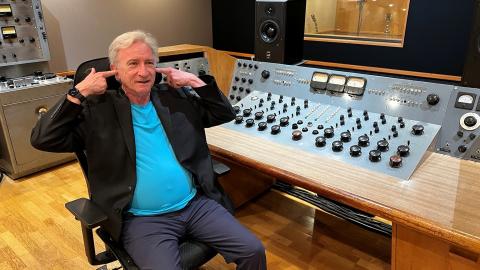
He has had a long career in the music industry, having started off as a musician and songwriter in San Francisco, where he played in several new wave bands and started learning production. He went on to work in Los Angeles at Cherokee Studios and Paramount before becoming an indie producer and moving to Germany where he was signed to BMG as a producer and also ran a small indie record label. He also did artist relations for Shure throughout all of Europe before moving back to L.A. and working for TASCAM. He later started his own PR/marketing company and present day is the chair of AES Los Angeles, host of “Insights in Sound,” co-founder of Artist Brain Collective, and an adjunct professor at UNLV. This interview was recorded on-location in Las Vegas, where he presently lives.
“It had been a very, very vibrant shipping area and … the area was on sort of a decline… So, things like that tend to really create interesting art scenes.”
“There are some bands and artists who come to you with less of an idea and less of an identity than others. And that, to my mind, is one of the roles of a producer is to basically work with the artist to figure out what their identity is, who they are.”
“If I'm producing a band, one of the most important aspects of that to me is, who are you as an artist? Why do I want to listen to you? Why do you want to listen to you? Why does anyone want to listen to you?”
“That, to me, is the mark of a brilliant artist, if they can reinvent themselves all the time.”
“The truth of the matter is there are a rare few artists who can self-produce; Prince or, I think Todd Rundgren did a great job of producing his own stuff …Brian Wilson, another one, great, great producer/artist. But for the most part, most artists benefit from having a producer who comes in as an objective third party, fifth Beatle, whatever you want to call it, and looks at their art and says, ‘Okay, here are some suggestions’.”
“There's a big, big difference between being an engineer and being a producer. That's left brain versus right brain. And in my ideal world, whenever I can, which is most of the time, I will have an engineer so that I can be the right brain. The engineer can be the left brain. That is 90% of the projects that I've done. That's what I do because I want that person being the technical person. I don't want to have to think about that.”
“I started as a teenager playing guitar and writing songs and stuff like that. But when I lived in San Francisco, I definitely got into playing with other people, which I think is really, really important to creativity.”
“I just turned around one day. I quit my job … and I said, ‘Hey, I'm going down to LA. I'm going to work in the studios’.”
“He starts showing me around there and he said, ‘Well, I can't take you in studio two right now because Crosby, Stills, and Nash are in there, but come on in studio one, we’re setting up for Elton John.’ And I just went, ‘Oh my God, how did I get this?’ And he said, ‘Can you start Monday?’ And I said, ‘Sure.’ And he said, ‘Well, if you want to come in tonight,’ it was a Friday, ‘we're having a record release party for David Bowie’.”
“I was fortunate enough during the time that I worked there to be a second engineer and a fly on the wall for sessions with producers like Phil Ramone and Peter Asher, Roger Béchirian, who produced Squeeze and Elvis Costello, all sorts of really, really legendary people. And I got to watch not just how they worked technically, but how they worked psychologically with the artist. And that shaped a lot of my own perspective on how to work with them.”
“I refer to myself as a lead actor in short attention span theater. I am always looking for something new.”
“We had a little independent label, myself and an engineer that I worked with. We had a little independent record label. We had put out a few records. We had distribution through Warner Electra in Europe. And we had put out, I'd say about half a dozen albums from different bands, projects that we had worked on.”
“I have found that there are a lot of characteristics that artists have in common: imposter syndrome, lack of organization or struggling with organization, procrastination, getting caught up in the process, a lot of it having to do with self-image and self-worth.”
“Attack on Sanctuary” (Unknown Pleasure)
“Real” (Max Benham)