







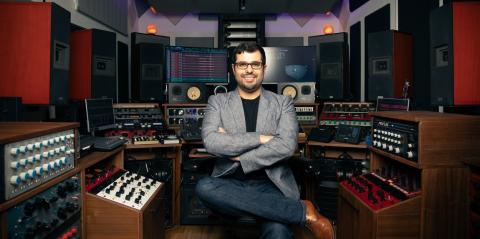
GRAMMY and Juno award-winning bassist, composer, engineer, producer, educator, and artist who last August released an eight-song album. He performs in a variety of traditional and contemporary music ensembles from around the world and is on faculty at Humber College, where he teaches audio production, performance, and composition. As a producer, mix engineer and mastering engineer, he has worked with artists from around the world in a wide range of musical styles. He is endorsed by more than a half dozen audio equipment companies and is a leader in immersive audio production, mixing and mastering Dolby Atmos content for artists worldwide. His official YouTube channel has more than one million combined video views.
“I wanted to expand it into this kind of three-dimensional experience where the ensemble is all around the listener, but at the end of the day, I just hope that that groove and the melodies played by all the artists … just bring joy to the listener.”
“I'm a bassist and … I jump between a couple things when I'm writing. I use my voice a lot, sing, I use piano a lot, I use guitar a lot and I use bass.”
“Yes, I write out the chord progressions. Yes, I'll even sometimes write out voicings, but interpretation is a part of this musical tradition. So, for piano players, guitar players, drummer… I have everything figured out. I've already worked with them on a rehearsal standpoint to know what the framework is, but as a producer, I'm also very passionate about creating a space where they can interpret and they can bring their voice.”
“For it to be chosen among my fellow nominees who I know very well, each of them in this category, for it to be chosen to win this (GRAMMY) is something I'll treasure forever. I mean that as an engineer, I mean that as a musician for my entire life. And I mean that in this case, very specifically as the artist for this record. I mean that's the part I think that's really just, it's hard to express fully what it means.”
“We wear our heart on our sleeve, and we share something that we believe in. And we share it not for awards, not for accolades. It's, we share it because it's something that is personal to me. It's something musical that feels like something I'd like to share with the world.”
“Immersive audio is referring in this case to the playing back of music that has been produced, not always composed and written for, but certainly produced and mixed in an immersive medium. And so, this can mean 5.1 surround. This could mean quadrophonic if someone wanted to go all the way back to the roots. It also, of course, has evolved into Dolby Atmos, Sony 360, or O3D, as well as discrete channel. And I mean by that, you can deliver a 12-channel audio mix that is designed for 12 channels, and it could be experienced that way.”
“I've had the pleasure of working on thousands of songs as a remixer reimagining music for artists around the world. Some really big records and famous records and orchestral records and independent records, so much music. And it's really changed the way in which I relate to sound, to on a fundamental level.”
“But as much as it's about sound and as much as it's about the sonic experience, at the end of the day, these are songs. These are pieces of music with melody, with form, with groove, with improvisation, and with a narrative. And so, I'm reminded at the beginning of the process as much as space was the integral inspiration for the project, once I start writing, … it's got to be a melody that moves me. It's got to be a chord progression that's bringing emotion. There's got to be groove ... It doesn't matter if there's 60 speakers or one speaker, a bass and a drum has got to groove.”
“Rather than having all the players around the array and now we get this this kind of hyper real capture of being in the middle of the ensemble, I'm doing it one layer at a time, drums, piano, strings, brass, percussion, tubla, vocals, soloists, violins, etc, etc, etc. And so, I'm positioning the microphones for every single layer so that I can capture the reflections and have that be a part of the mix so that they're already built into the space. I don't need to pan things around afterwards. I've already got them localized for the listener.”
“I did work with my assistant, and we had all our playlists and some of the songs, there's up to a thousand tracks because of the high microphone counts. It's not for the faint of heart. It's all at 96k. I had two computers working. So, you got to be organized. You got to know your DAW inside and out and be very, very intentional. But editing is a musical process. And so ultimately, it's about timing and just choosing your takes and just got to stay on top of making sure you don't leave anything behind or make any mistakes.”
“One of the benefits to being an artist and producer is I never allowed time to be an external pressure. I was not interested in doing this project unless I could see it through to the full extent of quality and musical intent that I wanted. And that meant sometimes that I ran out of time and I needed to extend and sometimes that I ran out of money. And I needed to do more work and save up to be able to afford the next step.”
“To me, the movie theater is a temple of art. I love it.”
“The biggest system I played it back on is a 64-speaker system at the Dolby headquarters in San Francisco. And it's the best listening experience I've ever had ever certainly of the record.”
“Music to me is not just an opportunity for an individual to be inspired and it does a great job at that. It is an opportunity to bring people together.”
“I love pop music. I love the producers of pop music. They're very, very practical in terms of being pretty ruthless when it comes to maintaining musical narrative and never wasting a moment.”
“Flow”
“Tapestry”